Most companies don’t fail at AI because of bad models. They fail because they never had a strategy.
That might sound blunt, but it’s what shows up again and again in enterprise settings. Teams jump into pilots, experiment with tools, hire a few data scientists—and then stall. Not because the tech didn’t work, but because the system around it didn’t exist.
If you’re leading AI inside an organisation, you don’t need more tools. You need structure.
This is where three simple but powerful blueprints come in: Strategy, Roadmap, and Architecture. Think of them as the minimum viable operating system for AI.
The Problem: AI Without Structure
Enterprise AI efforts often look like this:
- A handful of disconnected use cases
- Data scattered across systems
- No clear ownership or governance
- Pilots that never scale
It’s not a capability problem. It’s a coordination problem.
Without alignment between why you’re doing AI, what you’re building, and how it runs, things fall apart quietly—and expensively.
Blueprint 1: Strategy (Why + Where)
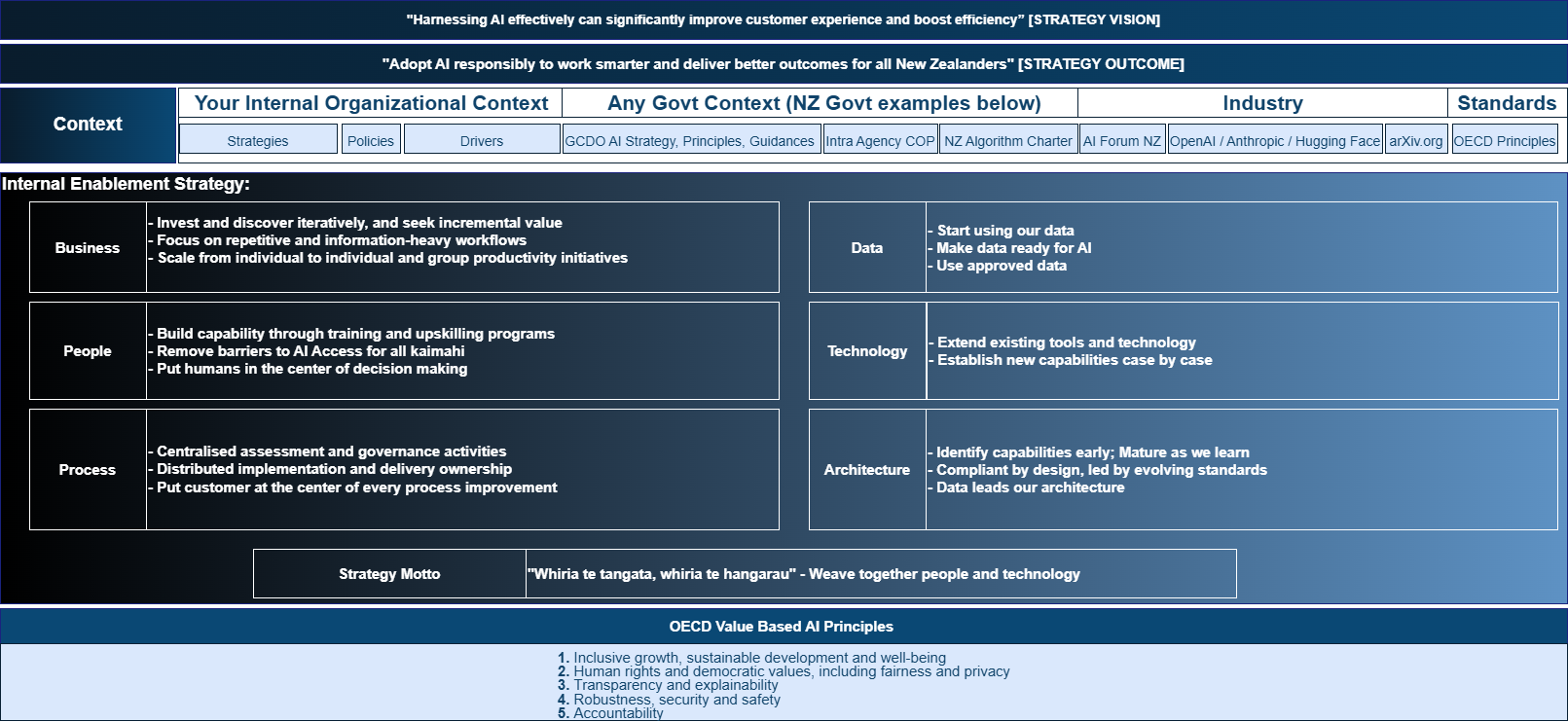
The strategy blueprint answers a deceptively simple question:
Where does AI actually create value for us?
This is not about listing use cases. It’s about making choices.
A good AI strategy:
- Anchors to business outcomes (cost reduction, revenue growth, risk mitigation)
- Identifies high-leverage domains (e.g. customer ops, supply chain, finance)
- Defines capability gaps (data, talent, tooling)
- Sets guardrails (ethics, governance, risk tolerance)
In practice, this means saying no to 80% of ideas so the right 20% can scale.
A common failure mode is treating AI as an innovation playground. It feels productive, but it rarely compounds. Strategy is what forces focus.
Blueprint 2: Roadmap (What + When)
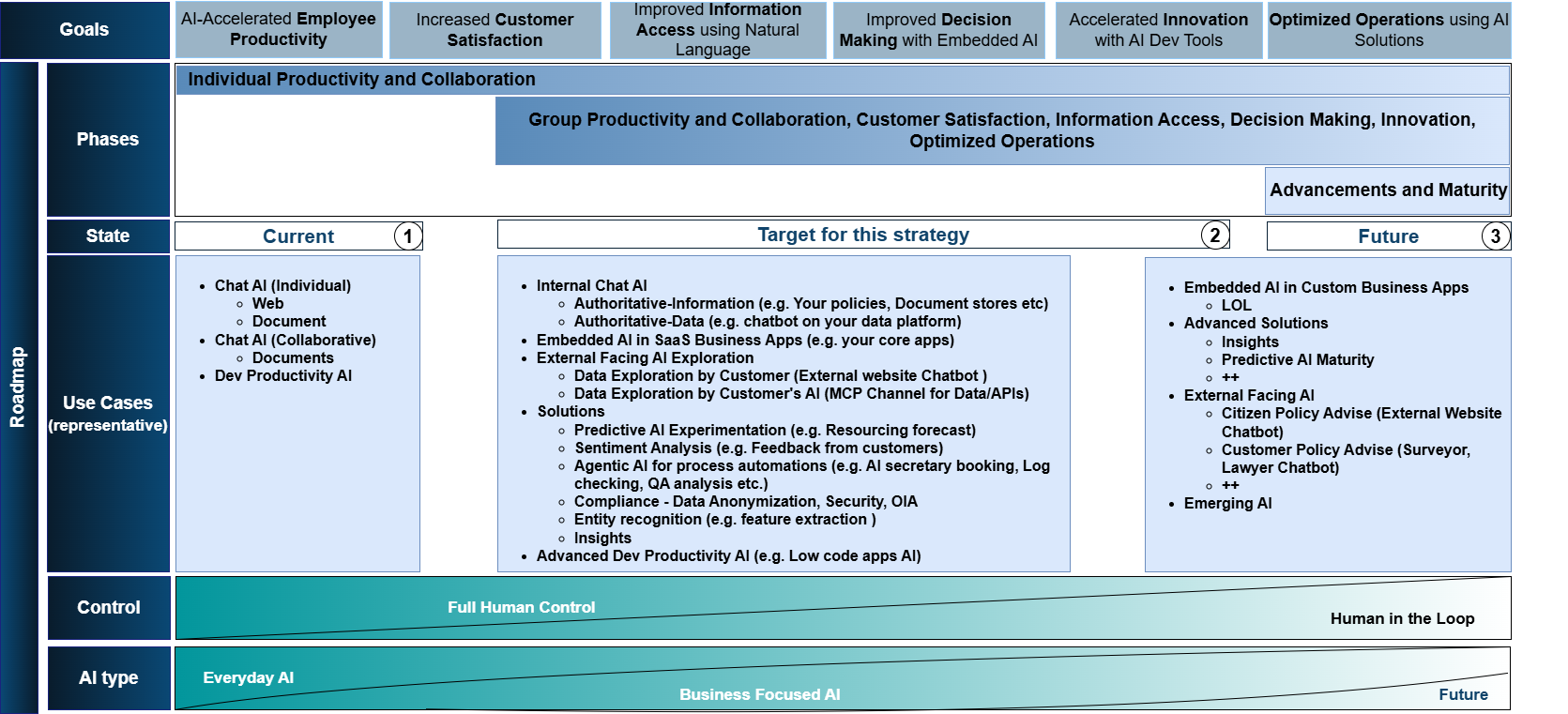
Once you know where to play, the next challenge is sequencing.
The roadmap blueprint translates ambition into execution:
- What do we build first?
- What dependencies exist?
- How do we move from pilot → production → scale?
A strong AI roadmap typically has three phases:
Foundation
- Data readiness
- Platform setup
- Initial governance
Pilot
- 2–3 high-impact use cases
- Tight feedback loops
- Measurable outcomes
Scale
- Reusable components
- Cross-functional adoption
- Operational integration
The key insight here:
AI maturity is not linear—it’s layered.
You don’t “finish” data before starting models. You evolve both together, intentionally.
Blueprint 3: Architecture (How It Actually Works)
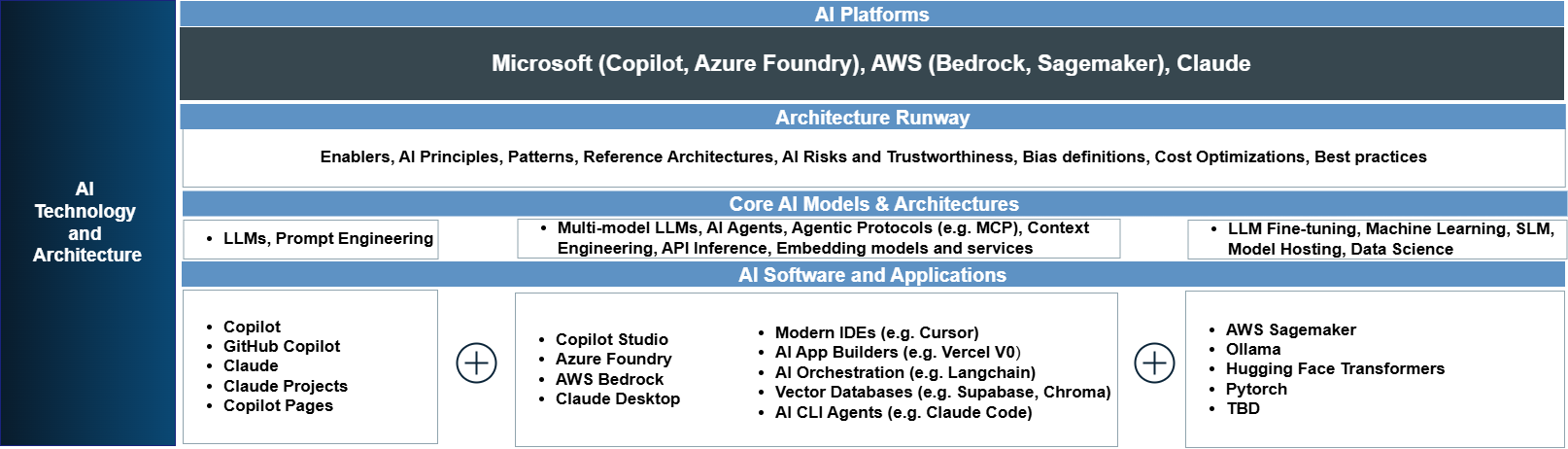
This is where most strategies quietly break.
You can have a clear vision and a solid roadmap, but without architecture, nothing scales.
The architecture blueprint defines:
- Data pipelines (how data flows and is cleaned)
- Model layer (ML, LLMs, or hybrid systems)
- Application layer (APIs, products, internal tools)
- Governance + monitoring (security, compliance, drift)
In enterprise environments, architecture decisions are less about tools and more about trade-offs:
- Centralised vs federated data
- Build vs buy
- Speed vs control
A practical rule:
If your second use case requires rebuilding everything, your architecture isn’t ready.
How These Three Fit Together
This is the part most people miss.
The blueprints are not separate documents. They are a system.
- Strategy defines intent
- Roadmap defines motion
- Architecture defines capability
If one is weak, the whole system slows down:
- Strategy without roadmap → ideas with no traction
- Roadmap without architecture → pilots that stall
- Architecture without strategy → expensive tech with no impact
When aligned, they create compounding momentum.
A Simple Example (Closer to Home)
Take a logistics company operating across New Zealand.
Strategy:
Reduce delivery delays by 20% and improve route efficiency.
Roadmap:
- Phase 1: Clean and unify delivery data
- Phase 2: Pilot route optimisation in Auckland
- Phase 3: Roll out nationwide
Architecture:
- Real-time data ingestion from fleet systems
- Prediction models for traffic and demand
- APIs feeding dispatch and driver apps
Nothing fancy. But tightly aligned.
That’s what makes it work.
Where to Start
If you’re leading AI in an enterprise, don’t start with tools. Start with clarity.
Use these blueprints as your baseline:
- Map your strategy to real business value
- Build a roadmap that respects dependencies
- Design an architecture that scales beyond one use case
And keep them connected. Always.
If you want to adapt blueprints to your organisation, feel free to reach out for the drawio xml code for these.
Why This Matters
AI is quickly becoming part of the operating fabric of modern organisations. Not a side project. Not a lab experiment.
The difference between those who extract value and those who don’t won’t be access to models.
It will be the ability to design systems that turn capability into outcomes.
These three blueprints are a simple place to start. Not perfect. But practical.
And in enterprise AI, practical wins.
Written for KiwiGPT.co.nz — Generated, Published and Tinkered with AI by a Kiwi