Your system already has APIs. Documentation. Schemas.
And yet an AI agent still can’t use it properly.
That’s not a tooling problem. It’s a channel problem.
For decades, every meaningful leap in software came from improving how we communicate with systems.
It started simply. You’d walk over to someone’s desk. Ask how things worked. Knowledge lived in people’s heads. Fast if you knew who to ask. Painful if you didn’t.
Then came the phone. Slightly better reach, still human-bound.
Email followed. Now things were written down. Persistent. Searchable. But also messy, fragmented, and buried in threads.
Then came HTTP. Machines started talking to each other. That unlocked the web.
On top of that, we built APIs. Structured access to systems. Predictable contracts. Developers could integrate without needing permission or context from another human.
For a while, that felt like the final form.
It wasn’t.
APIs were designed for developers.
Not for machines that need to act quickly, reliably, and repeatedly.
An AI agent can read documentation. It can parse schemas. It can even infer intent surprisingly well.
But here’s the catch.
It has to:
- search across multiple sources (docs, schemas, portals)
- interpret intent each time
- decide which API to call
- hope that decision is correct and consistent
That’s not a limitation of intelligence. It’s a limitation of the interface.
Humans tolerate this because we build mental models over time.
AI agents don’t get that luxury. Every interaction is closer to a fresh start.
So the real problems aren’t capability. They’re:
- Latency : too much reading before acting
- Ambiguity : multiple valid paths, unclear best choice
- Non-determinism : same task, different API choices each time
- Fragility : small doc changes can shift behaviour
That’s where things break.
If you look closely at a typical enterprise system, the pieces are all there.
API developer portals.
Database schemas.
Internal documents.
Tools sitting behind an API gateway.
Everything is well-structured—just not for the right audience.
All of it was designed for humans.
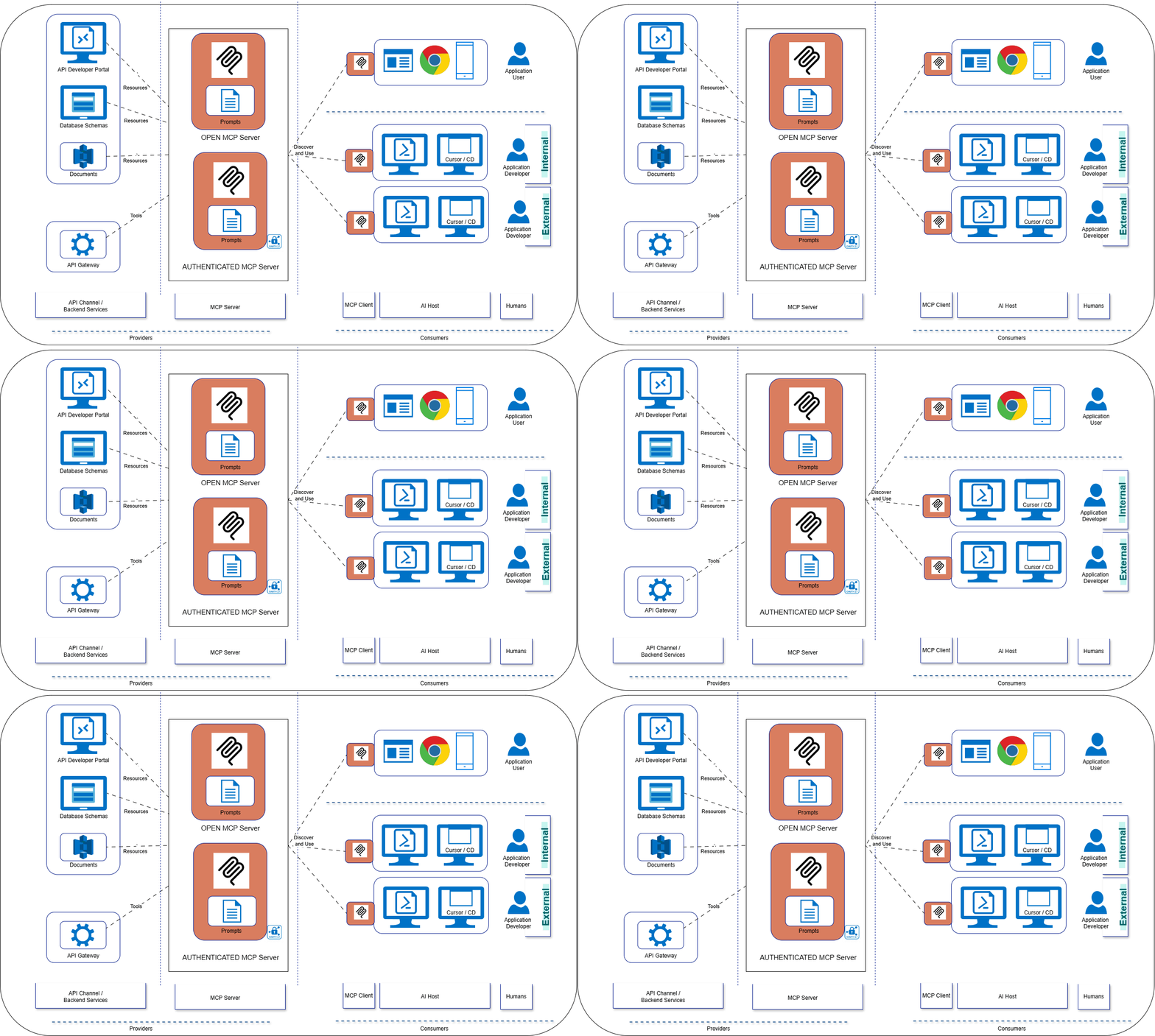
What’s missing is a channel designed specifically for AI agents.
That’s where the Model Context Protocol (MCP) comes in.
Not as another API. Not as another service.
But as a new layer altogether.
Think of MCP as the moment we recognise something fundamental:
AI agents are not just consumers of APIs.
They are a new class of users.
And like every new user class, they need their own interface.
In a typical MCP architecture, that interface sits between enterprise systems and AI agents.
On one side, you still have everything you’re used to:
- API portals
- Database schemas
- Documents
- Services exposed via an API gateway
On the other side, you have AI agents trying to act, reason, and complete tasks.
In the middle sits the MCP layer.
This layer is usually split into two parts.
An open MCP server, exposing general resources.
And an authenticated MCP server, handling secure, permissioned access.
But the real shift isn’t the servers.
It’s what they expose.
Instead of forcing an AI to figure things out each time, MCP standardises access to:
- Resources : curated, structured knowledge (APIs, schemas, docs)
- Tools : explicit, callable capabilities
- Prompts : reusable reasoning scaffolds
This changes the game.
You move from:
“Here’s everything, figure it out.”
To:
“Here’s exactly how to operate this system.”
The API gateway still does its job underneath. Nothing changes there.
Your existing systems remain intact.
MCP doesn’t replace your architecture. It makes it predictable for machines.
This is the part most teams underestimate.
They think AI integration means adding a chatbot, wiring up endpoints, or experimenting with prompts.
But the real question is deeper:
How do you make your system fast to understand, predictable to use, and safe to operate for an AI?
Every company will eventually answer this.
Some will build brittle layers of prompts and glue code.
Some will overload APIs with context they were never designed to carry.
A few will recognise the pattern early.
Every major shift in computing introduced a new interface layer.
GUIs made computers usable.
APIs made systems programmable.
MCP makes systems reliably operable by machines.
Why this matters
We’re moving into a world where AI agents don’t just assist, they act.
They trigger workflows, query systems, and make decisions within defined boundaries.
If your system isn’t designed for that, it becomes unpredictable.
If it is, it becomes composable, discoverable, and far more powerful.
Assets

Key takeaway
APIs gave us access.
MCP gives us control over how AI uses that access.
That’s the difference between something that works in demos and something that works in production.
How does it fit with the existing channels
This deserves it’s own page so watchout for my next post. Sign out for now.
Written for KiwiGPT.co.nz — Generated, Published and Tinkered with AI by a Kiwi