Your enterprise already has many channels.
Humans use some.
Machines use some.
And now AI is asking for its own.
In the last post, I explained why APIs are not enough and how MCP creates a new AI channel.
If you missed that, read it here first:
From APIs to AI Channels: The Next Evolution
This post is the next step.
We zoom out and see where this MCP channel actually fits.
For a long time, enterprises have been running on two types of channels.
First are human channels.
These are simple and familiar:
- In-person conversations
- Phone calls
- Emails
They are flexible. They carry context naturally. But they do not scale well.
Everything depends on people.
Then came digital channels.
These changed everything.
- HTTP
- APIs
- Web apps
- Mobile apps
Now systems could talk directly. No human in the middle.
This is how most product companies operate today.
Fast. Structured. Scalable.
But there is a gap.
Digital channels are built for:
- frontends
- backend integrations
- developers
Not for AI agents.
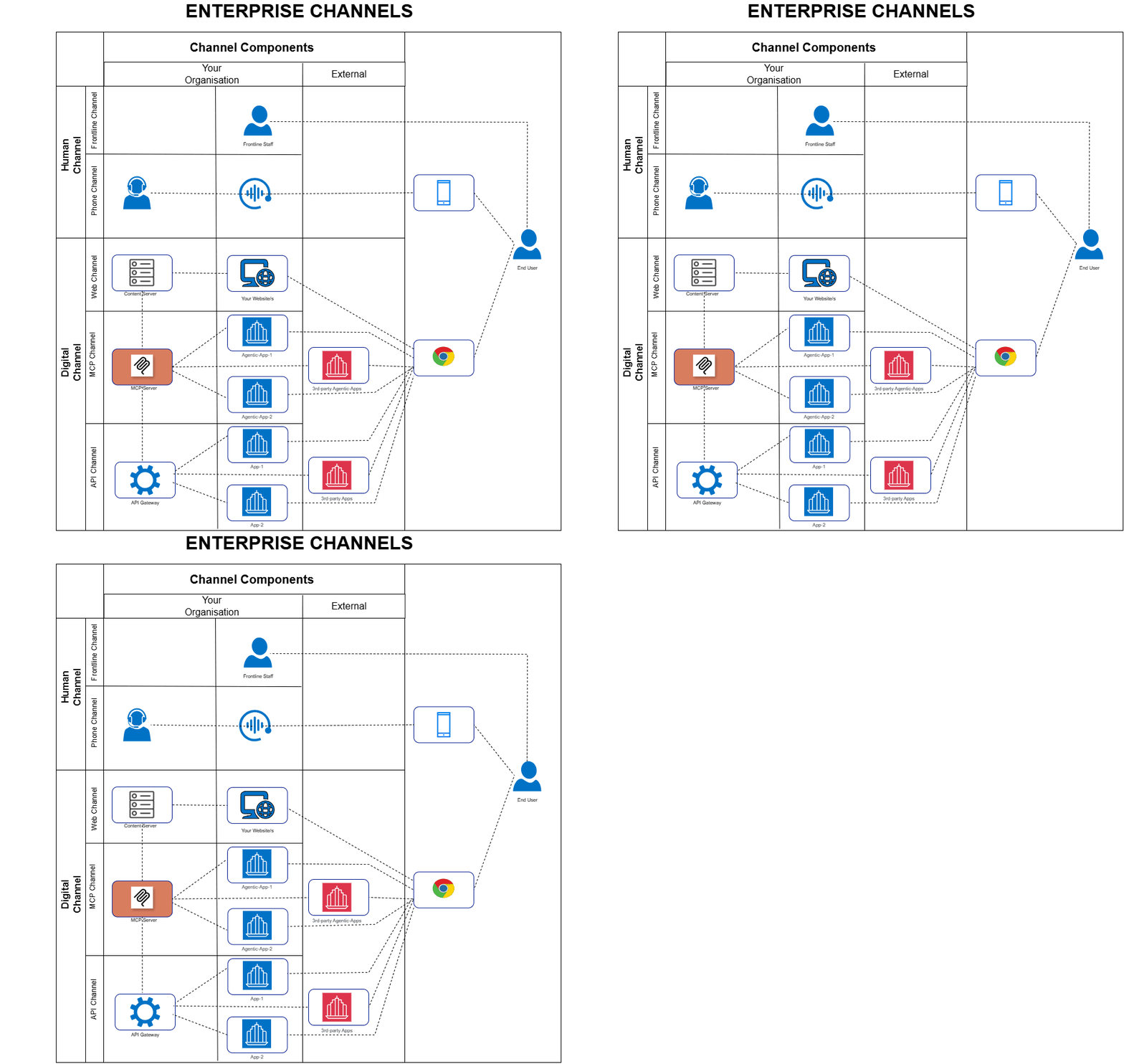
If you look at the architecture, you can see three clear layers.
1. Human channels
These sit on top.
People interact through:
- UI screens
- support calls
- emails
They bring judgment and flexibility.
But they are slow. And expensive to scale.
2. Digital channels
These sit in the middle.
This is where:
- APIs live
- services connect
- systems integrate
Everything is structured. Contracts are defined.
But still, these channels assume one thing.
A human developer designed the interaction.
3. MCP channel
This is the new layer.
A channel designed specifically for AI agents.
Not humans. Not traditional software.
But models that:
- read
- reason
- act
Here is the important difference.
An API tells you:
what you can do
The MCP channel tells AI:
how it should do it
Inside the MCP channel, three things become standard.
Resources
Structured access to APIs, schemas, and documentsTools
Explicit actions the AI can callPrompts
Guidance on how to think and decide
This reduces a big problem.
Without MCP, an AI has to:
- search documentation
- interpret meaning
- decide actions every time
With MCP, the system says:
Here is the correct path. Follow this.
This is not about making AI smarter.
It is about making systems easier to operate by AI.
Now when you combine all three channels, something interesting happens.
- Humans still handle edge cases and judgment
- Digital systems still handle execution
- MCP handles AI interaction in a structured way
Each channel has its role.
None of them replace each other.
This is why thinking in “channels” is useful.
Instead of asking:
How do we add AI to our system?
You ask:
What channel does AI use to interact with us?
Most teams today are mixing things.
They try to push AI into:
- APIs
- backend services
- frontend layers
It works for demos.
But it becomes messy very fast.
A cleaner approach is this.
Keep channels separate.
- Human channel for people
- Digital channel for systems
- MCP channel for AI
Now responsibilities are clear.
And architecture becomes easier to reason about.
Why this matters
AI agents are not just another client.
They behave differently.
They explore. They decide. They adapt.
If you force them into existing channels, you get:
- unpredictability
- higher latency
- inconsistent behaviour
If you give them a proper channel, you get:
- clarity
- control
- repeatability
Assets

Key takeaway
We did not replace human channels when APIs came.
We added a new one.
MCP is the same kind of shift.
Not a replacement.
A new layer in the system.
And once you see it like that, the architecture becomes much simpler.
Written for KiwiGPT.co.nz — Generated, Published and Tinkered with AI by a Kiwi