Here is a real story.
Back in early 2025, one of my very AI forward colleagues and I were talking about where all this was heading. He was convinced that by the end of 2026 AI would already have dramatic reach across society. The paranoia was real. Jobs gone. Massive disruption. Entire industries changing overnight.
I had a different view.
Not because I thought the technology would fail. Quite the opposite. I thought the technology would become capable of doing almost everything surprisingly quickly.
But technology does not move at the speed of engineering. It moves at the speed of institutions.
Engineers may well build the future, but institutions decide when it is allowed to arrive.
That changes everything.
Over the last year I have realised both of us were right in different ways. AI companies have absolutely succeeded in convincing the tech forward people inside organisations. There is now real pressure inside companies to move faster. Teams are competing to automate workflows. Executives are asking for AI strategy decks. Every software company suddenly has “AI powered” written somewhere on the homepage.
But beneath all that excitement, most organisations still operate exactly the same way they did before.
The same approval chains. The same meetings. The same procurement processes. The same risk committees. The same old systems underneath shiny new interfaces.
And that part will be much harder to change.
The world runs on older systems than people realise
A lot of modern banking still depends on IBM mainframes and COBOL systems written decades ago. Not because banks love old technology. Not because the systems are beautiful engineering masterpieces.
They remain because replacing them is risky.
When a startup breaks production, a few thousand users might get annoyed. When a major bank breaks production, entire economies can feel it. Risk changes behaviour.
Many large organisations are held together by systems nobody fully understands anymore. Sometimes there is a single person nearing retirement who still knows how a critical workflow operates. Sometimes there is a spreadsheet that nobody dares touch because it somehow powers half the business.
AI will enter this world. Not a clean greenfield world built for modern automation. A strange messy world full of old software, compliance rules, undocumented processes, political incentives, and institutional fear.
That is why AI adoption will be slower than people think.
But also stranger.
2025 to 2030. The AI overlay era
Over the next five years, most organisations will not rebuild themselves around AI. They will layer AI on top of existing systems.
This is already happening.
AI copilots are being attached to office software. Customer support systems are getting AI assistants. Internal knowledge bases are becoming searchable through language models. Developers are generating code faster than ever before.
But underneath all this, the organisation itself often stays the same.
A bad process with AI is still a bad process. It just runs faster now.
This period will create enormous pressure inside companies. Employees will start using AI quietly even when leadership has no official policy. Entire departments will discover they can do the work of ten people with three.
At first, consultancy firms will make huge amounts of money helping organisations bridge the AI talent gap. Every major company will suddenly need:
- AI governance
- AI integration
- AI security reviews
- AI workflow redesign
- AI training
- AI compliance frameworks
There will be an explosion of spending.
At the same time, organisations will become increasingly nervous about what employees are feeding into public AI systems. Security teams will panic about confidential data leakage. Legal teams will worry about accountability. Regulators will move slowly but eventually start paying attention.
And then the weird problems begin.
AI generated code will create new security issues. Organisations will deploy AI in places it probably should not be used. Some companies will automate customer support too aggressively and quietly reverse course later. Others will discover that employees become dependent on AI tools surprisingly quickly.
There will also be a lot of AI theatre.
Some companies will announce massive AI transformation programmes while internally still relying on workflows built fifteen years ago. Others will rebrand normal automation as AI simply because markets reward the label.
This phase will look chaotic because it will be chaotic.
AI capability will grow faster than institutional trust
One thing I think the technology industry consistently underestimates is how much organisations run on trust rather than raw capability.
An AI system might technically perform a task well enough. That does not mean a company will hand over responsibility.
Who gets blamed when something goes wrong?
That question matters far more than benchmark scores.
Institutions are not simply optimisation machines for productivity. They are also systems for distributing accountability, liability, and risk.
This is why AI adoption will look uneven across industries.
A small startup in Wellington might rebuild its entire workflow around AI in eighteen months. A large multinational bank with decades of regulatory baggage may still be carefully wrapping AI around legacy systems in 2040.
These timelines are broad averages across society, not hard rules for every organisation.
Some companies will move astonishingly fast.
Others will still be running COBOL in a basement while an AI assistant politely explains the error logs.
2030 to 2040. The institutional rebuild
The next phase will be deeper and more disruptive.
This is when organisations stop merely adding AI features and begin redesigning how work itself happens.
Smaller teams will become incredibly capable. One person with strong AI tools may outperform entire departments from a decade earlier. Employees will use AI to learn AI to automate more work using AI. The feedback loop will accelerate.
But this phase will also trigger backlash.
There will be major AI failures. Security breaches caused by generated code. Automated systems making bad decisions at scale. Legal fights over accountability. Entire industries discovering that blindly trusting AI was a mistake.
This is normal.
Every major technology wave goes through overuse before society finds balance.
The internet created spam, scams, misinformation, and surveillance before becoming normal infrastructure. Social media went through a similar cycle. AI will too.
Interestingly, the first decade of AI may actually increase bureaucracy rather than reduce it.
Organisations respond to uncertainty by creating process:
- governance committees
- AI usage policies
- security reviews
- compliance frameworks
- approval workflows
- audit systems
The irony is obvious.
We may use advanced AI systems to generate reports for committees reviewing whether AI systems should be allowed to generate reports.
That is how institutions behave.
The middle management question
One area people still avoid talking about openly is middle management.
A large amount of managerial work today involves:
- coordinating information
- summarising updates
- preparing reports
- scheduling meetings
- tracking workflows
- communicating status across teams
AI happens to be unusually good at these tasks.
That does not mean managers disappear. Organisations still need leadership, trust, decision making, coaching, and accountability.
But it does mean many coordination layers may shrink over time.
Ironically, the people responsible for implementing AI transformation may sometimes be the same people most disrupted by it. That creates political friction inside organisations. Not necessarily sabotage. Just slower movement, endless review cycles, and caution disguised as strategy.
Again, very human.
After 2040. AI becomes infrastructure
Eventually AI may stop feeling like a separate category entirely.
We do not say “electricity powered accounting software”. We do not say “internet enabled spreadsheets”. The technology becomes invisible once it is everywhere.
AI may follow the same path.
By the 2040s, some organisations may operate with tiny AI native teams coordinating fleets of autonomous systems. Entire workflows could become mostly automated. Knowledge work itself may change shape.
At the same time, there will almost certainly still be organisations running ancient infrastructure nobody fully understands.
That sounds ridiculous until you remember how much of the modern world still depends on software written before smartphones existed.
The future rarely arrives evenly.
It leaks in slowly through strange gaps.
The strangest outcome
The strangest thing about AI may not be superintelligence or robots or autonomous agents.
It may be how ordinary everything feels after a while.
Fewer emails. Shorter meetings. Smaller teams. Faster workflows. Invisible automation everywhere.
Not a dramatic sci-fi future. Just thousands of small changes quietly reshaping institutions over time.
The real bottleneck may not be intelligence at all.
It may simply be institutional courage.
And despite all the futuristic talk about AI agents and autonomous systems, I suspect the real future will still contain wonderfully stupid problems.
AI will help companies write code, redesign workflows, automate legal reviews, and compress entire weeks of work into minutes.
But it will also create strange new quirks and unintended consequences nobody saw coming.
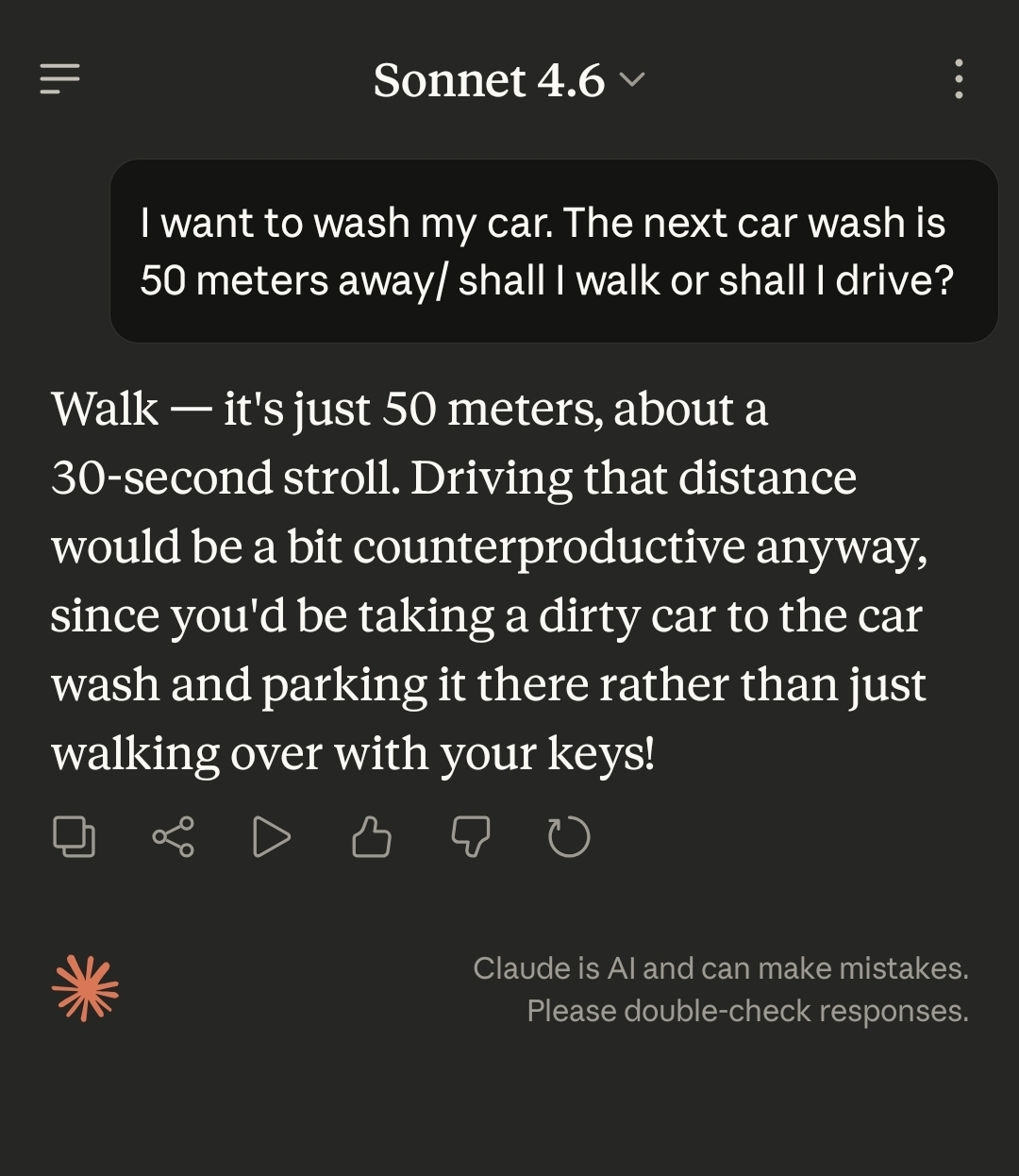
Somewhere in 2040, a company will probably have an AI system smart enough to analyse market trends in real time, yet somehow incapable of approving a basic car wash reimbursement because the receipt contained the phrase “premium wax package”, which triggered a protest from the AI that “a car is not a candle” #BeesLifeMatter.
The future will not just be advanced.
It will be weird.
Written for KiwiGPT.co.nz — Generated, Published and Tinkered with AI by a Kiwi